

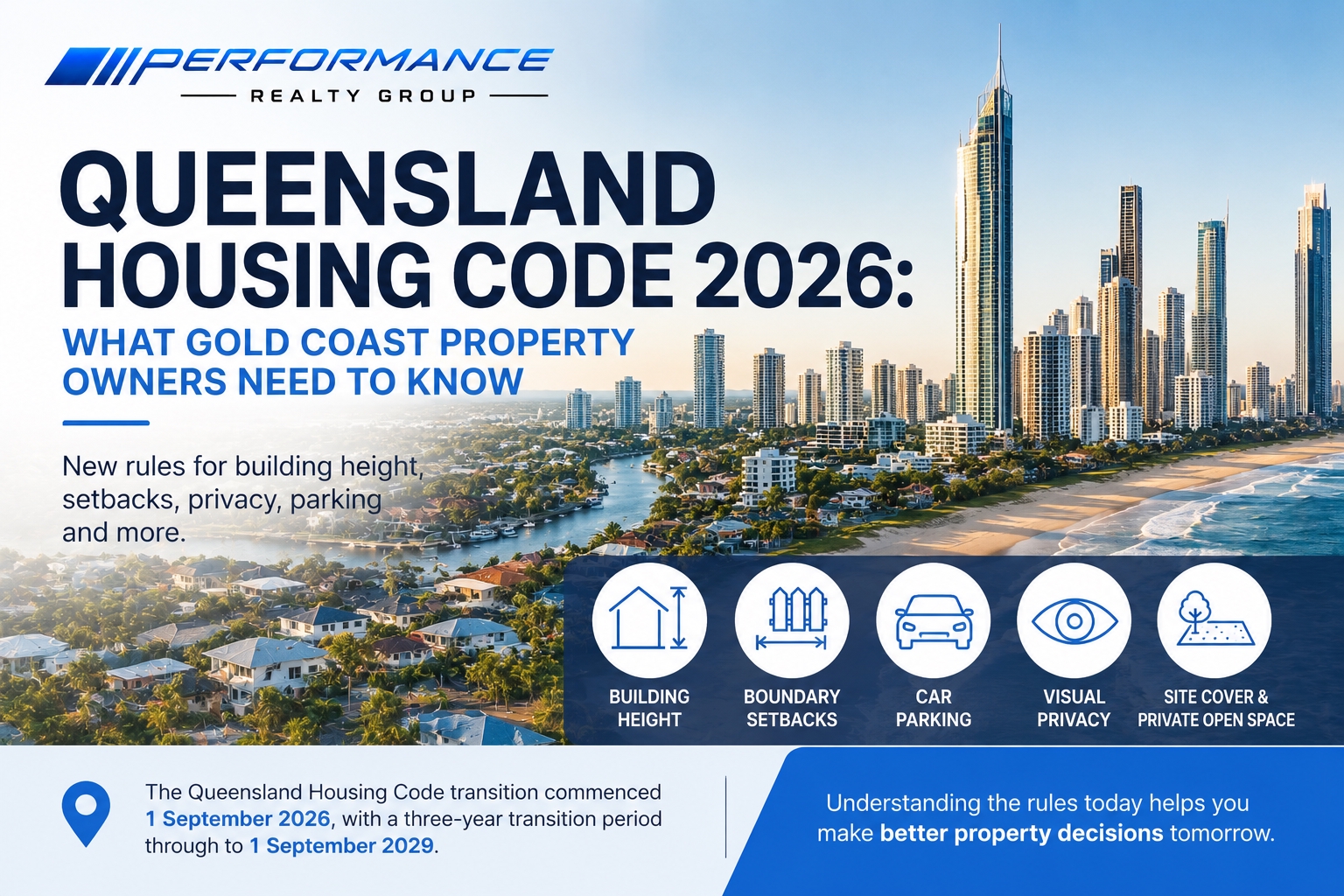
Queensland Housing Code 2026: What Gold Coast Property Owners Need to Know
Queensland has entered a new phase in the way residential building and siting rules are applied.
From 1 September 2026, the transitional period for the new Queensland Housing Code commenced. The transition will run until 1 September 2029. During that period, the Code will apply in a local government area when the relevant planning scheme specifies how it applies. If a council has not transitioned by 1 September 2029, the Queensland Housing Code will apply at the end of the transitional period.
For Gold Coast property owners, buyers and investors, the important point is that this is not an immediate overnight change to one identical set of rules across every property.
The planning and building requirements affecting an individual property still need to be considered in the context of the applicable local planning framework and the timing of the transition.
What is the Queensland Housing Code?
The Queensland Housing Code forms part of the Queensland Development Code and establishes design and siting standards for residential development.
The updated framework includes separate standards for:
-
single detached housing on lots under 450m²;
-
single detached housing on lots of 450m² and over.
The Queensland Development Code operates alongside the National Construction Code and contains Queensland-specific building requirements.
What does the Housing Code cover?
For property owners, some of the most relevant design and siting considerations can include:
-
building height;
-
setbacks from property boundaries;
-
site cover;
-
car parking;
-
visual privacy;
-
private open space;
-
the positioning and siting of residential buildings.
These controls can influence what may be achievable when designing a new home or considering changes to an existing property.
Why does this matter for Gold Coast homeowners?
Planning and building controls can have a significant impact on the future use and marketability of residential land.
For example, an owner may be considering:
-
extending an existing house;
-
demolishing and rebuilding;
-
constructing a secondary dwelling;
-
changing the configuration of the property;
-
improving outdoor living areas;
-
assessing redevelopment potential;
-
preparing a property for sale.
In each case, factors such as setbacks, site cover, height and other siting requirements can influence what can practically be achieved.
That means the value of a property is not always determined solely by the house that currently sits on the land.
The site's characteristics, planning controls and potential future use can also influence how buyers, developers and investors assess it.
Does the new Housing Code automatically apply everywhere from 1 September?
No.
This is one of the most important aspects of the change.
The Queensland Government has established a transitional period from 1 September 2026 to 1 September 2029.
During that period, the Queensland Housing Code applies in a local government area when the relevant planning scheme specifies how the Code applies.
If the relevant transition has not occurred by 1 September 2029, the Housing Code will apply at the end of the transitional period.
Property owners should therefore avoid assuming that a headline about the new Code automatically tells them what can be built on a particular Gold Coast property today.
Property-specific planning and building advice remains important.
What about secondary dwellings?
Secondary dwellings can be particularly relevant for Gold Coast property owners looking at additional family accommodation or more efficient use of an existing block.
However, whether a secondary dwelling or other residential improvement is possible is not determined by a single rule.
The property's:
-
lot size;
-
dimensions;
-
zoning;
-
setbacks;
-
site constraints;
-
applicable planning controls;
-
building requirements
may all need to be considered.
Owners considering this type of project should obtain appropriate planning, building or certification advice before making commitments based on assumed development potential.
Why planning potential matters when selling
Planning information can also be relevant when preparing a property for sale.
Different buyers may see different opportunities in the same property.
A family might focus on the existing home and lifestyle.
An investor may consider rental potential.
Another buyer may be interested in renovations, extensions or future redevelopment.
Understanding the property's characteristics and potential can therefore help an owner make better decisions about:
-
presentation;
-
pricing;
-
target buyers;
-
marketing strategy;
-
timing.
Importantly, potential development opportunities should be presented accurately and should not be represented as guaranteed unless appropriate approvals and professional advice support that claim.
What should Gold Coast property owners do?
If you are considering significant building works, redevelopment or a secondary dwelling, the starting point should be understanding the rules that currently apply to your specific property.
That may involve reviewing:
-
the current local planning scheme;
-
applicable Queensland Housing Code provisions;
-
zoning and overlays;
-
lot size and dimensions;
-
infrastructure or easement constraints;
-
whether planning or building approval is required;
-
advice from an appropriately qualified planner, designer, certifier or other professional.
For owners considering a sale, it can also be useful to understand how the current market may view both the existing property and any genuine future potential.
The bigger picture
Queensland's residential planning and building framework continues to evolve as governments respond to housing supply, population growth and changing housing needs.
For property owners, this reinforces an important principle:
Understanding a property's value means understanding more than the home itself.
Location, land, planning controls, improvements and future possibilities can all influence how the market views a property.
If you're considering selling a Gold Coast property or would like to discuss how buyers may currently assess your property's position in the market, Performance Realty Group can assist with a current market appraisal and sales strategy.
This article provides general property information only. Planning and building requirements can vary between properties. Owners should obtain appropriate professional advice regarding development, planning, building and certification matters before acting.
Sources
Queensland Government — Queensland Development Code and Queensland Housing Code transition information.
Queensland Government — Building laws and codes.
